Readers of this blog have heard me describe costume jewelry in a variety of ways: gorgeous, graceful, exquisite…as well as lifeless, insipid, tired, and “what were they thinking?” ugly. But today I am going to show you a few pieces that are just plain ODD.
Hair Jewelry
I’m guessing that most people would be charmed find that their grandmother tucked a tiny curl of her baby’s hair in a locket. But how would you feel if she had saved hanks of hair from her dead husband to weave into a bracelet?
Jewelry made of human hair was a “thing” in the late 1800s. I was first exposed to this alarming phenomenon through an episode of “Antiques Roadshow” a few years ago when a kindly lady brought in her collection to be appraised.
The bracelet shown above is available for purchase today on Etsy.
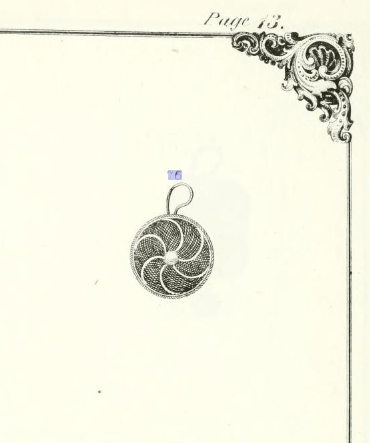
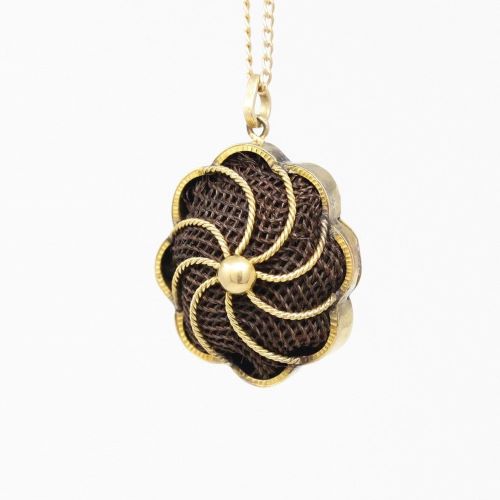
Shown below is page 13 from the 19th century book “Self-Instructor in the Art of Hair Work, Dressing Hair, Making Curls, Switches, Braids, and Hair Jewelry of Every Description” by Mark Campbell. In addition to instructions, the book also includes mountings available for purchase. By sending $10 to Mr. Campbell, presumably with your beloved’s hair, you could receive the pendant shown on the left, below. It is remarkably similar to the pendant shown on the right, which is another piece of hair jewelry you can find for sale today.
A favorite motif of jewelers is the flower basket or flower vase. First popularized in the seventeenth century, this form has been going strong ever since. It’s fascinating to see how designers have interpreted this motif in fine gems as well as humble materials over the years.
Medieval Pilgrim Badge
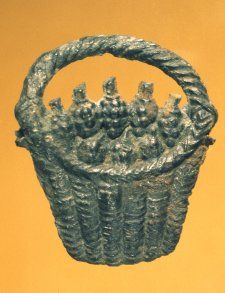
The earliest flower basket brooch I found is more accurately called a “fruit” basket, because I think those are bunches of grapes nestled in the basket. The brooch dates from the middle ages, somewhere between 500 – 1500 AD.
Medieval Pilgrim Badge Copyright British Museum
18th Century Diamond Brooch
The lovely brooch shown below is from the Cooper-Hewitt Museum in New York. It is made of silver and gold set with diamonds. It was likely made either in France or England and dates to 1750 to 1790.
Diamond Brooch, Second Half of the 18th Century Copyright: Cooper-Hewitt Museum
Fabulous Belle Epoque Gemstone Brooch
I think most of the prettiest flower basket brooches date from the Belle Epoque, the period from the late 1800s until the outbreak of World War I in 1914. The piece below was made in Paris in 1890. It is made of gold and platinum and is set with diamonds, rubies, emeralds and sapphires. What a beauty!
Belle Epoque Flower Basket Brooch Copyright: Victoria and Albert Museum, London
Another 1890s “Giardinetti” Brooch
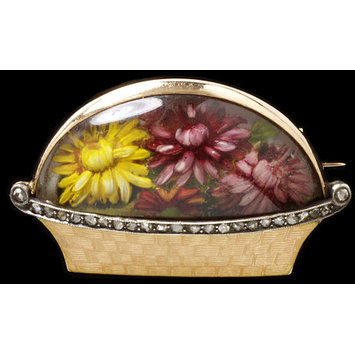
Jewelry made in the form of vases or baskets of flower was termed “giardinetti” from the Italian for “little garden.” The giardinetti brooch below was made at approximately the same time as the one above. It’s fun to think that a stylish lady might have looked at both of them in the same shop window. This one has a much more rustic look, though it was also made with gold and diamonds. The flowers are formed from rock crystal that has been carved and enameled from the reverse. The basket is also enameled.
Rock Crystal, Diamond, Gold and Silver Brooch Copyright: Victoria and Albert Museum, London
1940s Moonglow Flower Basket Brooch
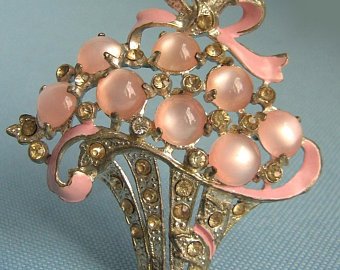
One style of flower basket is ubiquitous on the vintage jewelry market. Two examples from my shop are shown below. Made of pot metal and often enameled, each is set with faux moonstone glass cabochons. Because the stones seem to glow from within, they are often called “moonglow.”
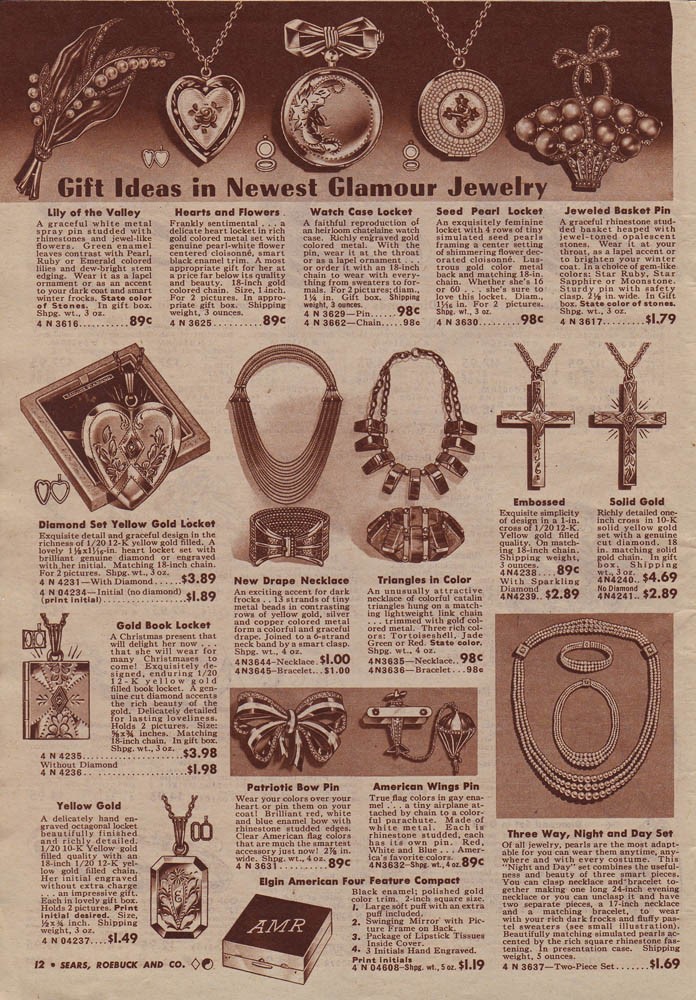
It isn’t surprising that these brooches are so plentiful on the secondary market when you realize that a similar one was featured in the Sears Roebuck catalog of 1940. (See upper right hand corner, below.) Thousands of women must have purchased them!
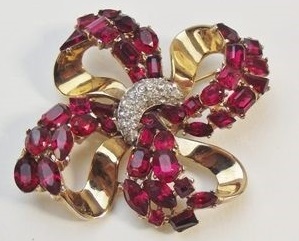
I love jewelry featuring bows. I am not alone. I’d guess that virtually all major jewelry designers have created at least one, and probably many pieces featuring bows, either as the main motif or as a secondary design element.
In her delightful book, “Jewelry – From Antiquity to the Present,” Clare Phillips notes “The bow was one of the most popular motifs in Baroque jewelry, probably developing out of the ribbons which were tied at the top of a jewel as a means of securing it.”
It certainly sounds plausible that a clever goldsmith of the 17th century could look at the black velvet ribbon holding a pearl drop against a lady’s decolletage and be inspired to construct a bow-shaped jewel from metal and gemstones.
But bows were already popular as trims for dresses, as the two pictures below demonstrate.
Hortense Mancini by Gennari II
Portrait of Femme by van der Helst
Wouldn’t any of these fabric bow trims look fetching if constructed out of gold and gemstones?
But anyway, who cares how the motif came about? Bows have a long and venerable history and the motif is still popular today.
Bow Designs: Inspired or Tired?
Because bow-motif jewelry has been around for centuries, every design permutation has likely been done a million times. Romantic droopy bows with pearl drops? Yup. Droopy bows called “sevignes” were the rage in the 17th century and are still gorgeous in the 21st — see the adorable Ciner earrings shown above. Tailored bows in vermeil? See the 1940s. Perky golden bows? See the 1960s. Bakelite bows? Double bows? Bow ties? Circle pins with bows? Kittens with bows? Floral sprays with bows? It’s all been done.
Certainly some bow jewelry seems lifeless, insipid, unimaginative and even ugly. But isn’t it amazing that, after being a fixture of jewelry design for 400 years, so many pieces are graceful, charming, inspired and just absolutely gorgeous?
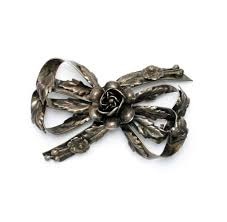
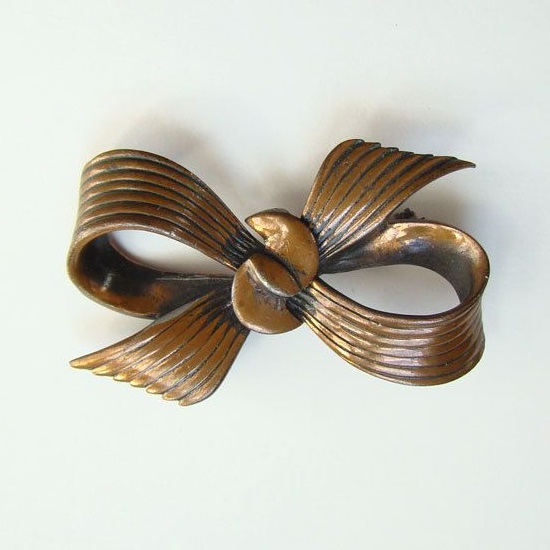
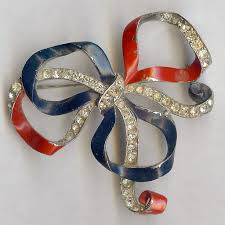
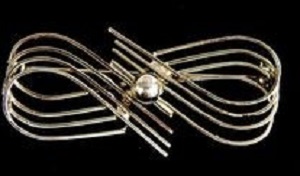
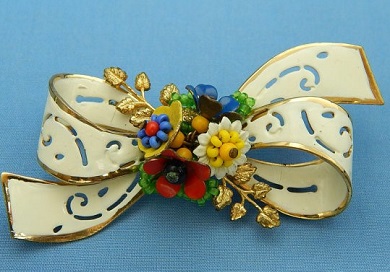
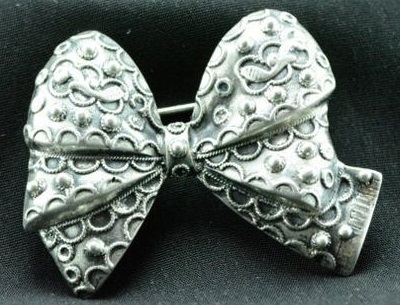
Here are some examples of vintage costume jewelry bows. Some of these I think are adorable. Others I think are kind of drab. There is even one that falls into the “What were they thinking?” category. How would you rate them? Inspired? Or Tired?
Pearl strands are a staple of most women’s jewelry wardrobes.
Indeed, strings of pearls are so ubiquitous that several jewelers have marketed “add-a-pearl” schemes as a cost-effective way for each little girl to have this coveted necklace, presumably by the time she is a bride.
The “add-a-pearl” necklace begins with a “starter” chain with one pearl. On birthdays and other milestone events, another pearl is added, so that the recipient eventually has a complete pearl strand. (See story here .)
Favorite of First Ladies
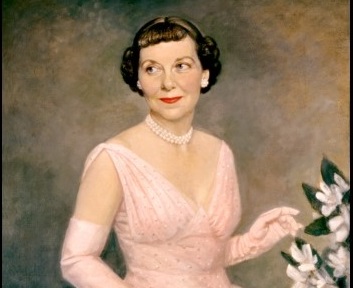
In 1953 Mamie Eisenhower commissioned the Trifari company to make a costume jewelry pearl choker to accessorize her inaugural ball gown.
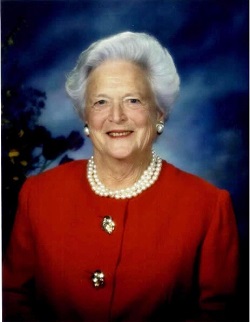
Jackie Kennedy Onassis and Barbara Bush famously wore three-strand pearls all of the time. ALL OF THE TIME.
(Glancing through the portraits of First Ladies at the White House Historical Association web site, it looks like about 13 of the 44 First Ladies were wearing pearls when their likeness was captured, starting with Julia Tyler in 1844 and ending with Michelle Obama.)
So we know already, pearls are a true classic.
But let’s confirm this by using our “mail order catalog” methodology.
Pearls in Mail-Order Catalogs
Pearls appear in almost all Sears catalogs I surveyed, from 1912 to 1986.
The photo (below) shows Sears’ advertisement for “indestructible pearls”, which they lumped together with other bead necklaces in 1912.
“Indestructible Pearls” from Sears catalog, ca. 1912
Although pearls do appear in the 1912 catalog, they are far outnumbered by solid gold and gold-filled lockets, sash pins, and brooches. There is even a quarter of a page devoted to jet and black enamel jewelry, which I would have suspected would be going out of fashion about this time.
But back to pearls.
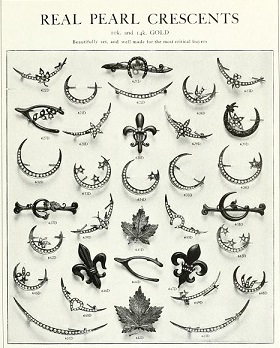
The PW Ellis jewelry company catalog of 1915 – 1916 shows a number of “real pearl necklaces” along with a good selection of adorable tiny brooches set with seed pearls, called “pearl crescents”. (These seed pearl crescents show up on the secondary market frequently, but so far none has met my rather rigid budgetary requirements.) But I love them!
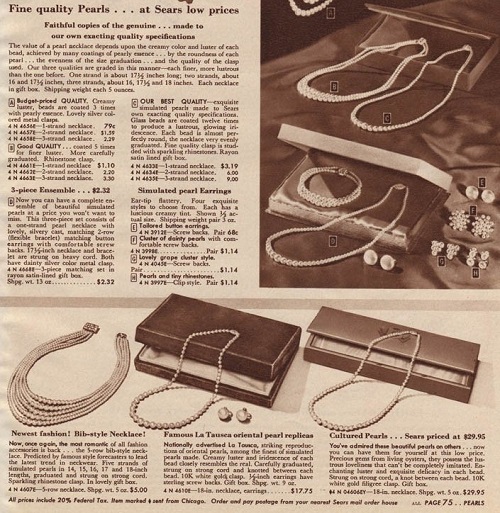
By 1947, even the Sears catalog had a large selection of pearl strands, at many different price points, from 79 cents for a 1-strand budget option to $29.95 for cultured pearls with a 10 karat gold clasp.
Pearl strands were a fixture throughout the 1950s, with more styles and qualities of cultured pearls available.
The popularity of pearls must have started to wane in the late 1960s, at least to Sears customers, perhaps due to hippies, Flower Power, and the rise of the mod look. In any event, pearls can’t be found in the 1969 Christmas book, nor in the 1979 Christmas book, (though a strand of imitation pearls makes a furtive appearance in the clothing section of the 1972 book.)
In 1969, Sears promoted a large variety of jade items, some carved ivory pieces, some “with-it jewelry” including a snake bracelet and a ring with the word “Peace” written in a semi-psychedelic font, and commemorative birthstone jewelry targeted for mothers and grandmothers. Pearls do appear — in the form of pearl rings and pearl-studded items — but there are no strings of pearls.
In 1979 must have been the beginning of the “gold chain” era. The 1979 catalog is full of gold chain necklaces and dinky pendants and again, no strings of pearls.
Fortunately, pearls make a comeback in the 1983 catalog with both cultured pearls and a couple of sets of Marvella fakes making a showing.
Fresh-water pearls appear in the Sears 1987 catalog.
The graph showing the occurrence of pearl strands in selected mail-order catalogs is below.
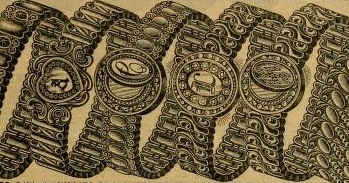
You’ve probably seen these bracelets for sale at flea markets and on vintage jewelry sites. They are generally made of gold-tone metal and often have a central plaque or medallion that can be engraved.
Expansion Bracelets – PW Ellis Company, 1915
The links are connected so that the bracelet expands to grip any size wrist. (The same principle exists today in some watch bands.)
Were expansion bracelets a fad, a trend, or a classic?
Since they are not around today, we can be pretty sure they are not classics. But there are an awful lot of these things on the secondary market…. So were they a fad or a trend?
Before we decide, let’s get some definitions out of the way. What exactly is a fad, anyway? Surprisingly, the critical factor isn’t anything intrinsic to the way the item looks – it’s how long it lasts in the marketplace.
Costume jewelry is generally considered to be a part of the fashion industry. Bean-counters use the same term for those jeans with the ripped knees as they do for that sparkly knuckle ring you bought on ebay: FAD.
The sales exec is vitally interested in one thing: “How many people will buy my product this month? How many people will buy my product next month? How many people will buy my product the month after that?” Or put another way, “Will my product be a flop? A fad? A trend? Or (cross my fingers) a classic?”
It’s the longevity of the product in the marketplace that defines whether a fashion is a fad, not the fact that it is poorly made, or it makes you look like a blimp.
A fad doesn’t last long.
A trend (also called a “fashion”) lasts longer and reaches more people.
But the Holy Grail is the true classic or “modern classic” – an item that reaches lots of people and year after year, is a perennial seller.
Now that we have the definitions out of the way, let’s move on the fun part: Was it/Is it a fad, trend, or a classic?
To find out, I looked at a sampling of mail-order catalogs from 1902 to 1986.
My guess was that these bracelets were a fairly short-term trend, probably starting in the 1930s and ending in the early 1940s.
Boy was I wrong. The venerable expansion bracelet first showed up in my sample in 1912 — in Sears Catalog Number 124 — and lasted until 1962. I couldn’t find it in my catalogs in the 1930s, but I bet it was still around. (Mail order catalogs during the Great Depression didn’t devote many pages to fripperies like jewelry.)
Here is a picture of the expansion bracelet from the 1962 Sears Christmas Catalog. Note it was sold with a matching locket, and was marketed for teens. (I’ve seen this marketing behavior before — shortly before a trend dies its natural death, marketers try to pitch it to kids or teens.)
Expansion Bracelet and Locket set from 1962 Sears Wish Book
Stay tuned for more posts in the series “Fad, Trend, or Classic?” Coming up: Pearls, Cameos, Charm Bracelets, and more.























 Gemboree Vintage