
Pearl strands are a staple of most women’s jewelry wardrobes.
Indeed, strings of pearls are so ubiquitous that several jewelers have marketed “add-a-pearl” schemes as a cost-effective way for each little girl to have this coveted necklace, presumably by the time she is a bride.
The “add-a-pearl” necklace begins with a “starter” chain with one pearl. On birthdays and other milestone events, another pearl is added, so that the recipient eventually has a complete pearl strand. (See story here .)
Favorite of First Ladies
In 1953 Mamie Eisenhower commissioned the Trifari company to make a costume jewelry pearl choker to accessorize her inaugural ball gown. 
Jackie Kennedy Onassis and Barbara Bush famously wore three-strand pearls all of the time. ALL OF THE TIME.


(Glancing through the portraits of First Ladies at the White House Historical Association web site, it looks like about 13 of the 44 First Ladies were wearing pearls when their likeness was captured, starting with Julia Tyler in 1844 and ending with Michelle Obama.)
So we know already, pearls are a true classic.
But let’s confirm this by using our “mail order catalog” methodology.
Pearls in Mail-Order Catalogs
Pearls appear in almost all Sears catalogs I surveyed, from 1912 to 1986.
The photo (below) shows Sears’ advertisement for “indestructible pearls”, which they lumped together with other bead necklaces in 1912.
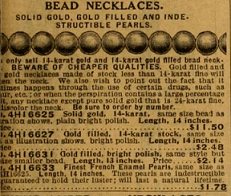
Although pearls do appear in the 1912 catalog, they are far outnumbered by solid gold and gold-filled lockets, sash pins, and brooches. There is even a quarter of a page devoted to jet and black enamel jewelry, which I would have suspected would be going out of fashion about this time.
But back to pearls.
The PW Ellis jewelry company catalog of 1915 – 1916 shows a number of “real pearl necklaces” along with a good selection of adorable tiny brooches set with seed pearls, called “pearl crescents”. (These seed pearl crescents show up on the secondary market frequently, but so far none has met my rather rigid budgetary requirements.) But I love them!


By 1947, even the Sears catalog had a large selection of pearl strands, at many different price points, from 79 cents for a 1-strand budget option to $29.95 for cultured pearls with a 10 karat gold clasp.
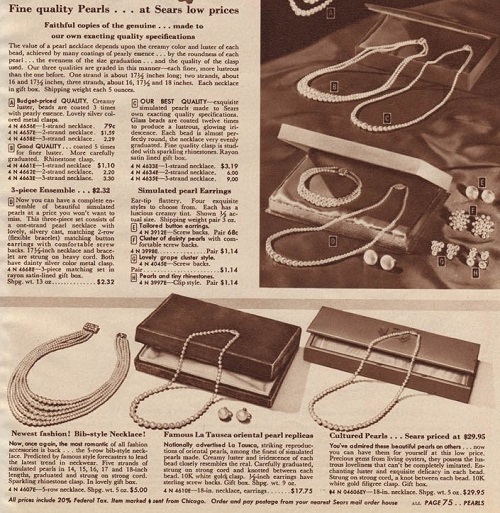
Pearl strands were a fixture throughout the 1950s, with more styles and qualities of cultured pearls available.
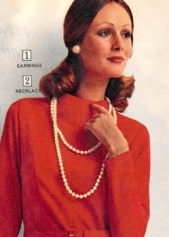
The popularity of pearls must have started to wane in the late 1960s, at least to Sears customers, perhaps due to hippies, Flower Power, and the rise of the mod look. In any event, pearls can’t be found in the 1969 Christmas book, nor in the 1979 Christmas book, (though a strand of imitation pearls makes a furtive appearance in the clothing section of the 1972 book.)
In 1969, Sears promoted a large variety of jade items, some carved ivory pieces, some “with-it jewelry” including a snake bracelet and a ring with the word “Peace” written in a semi-psychedelic font, and commemorative birthstone jewelry targeted for mothers and grandmothers. Pearls do appear — in the form of pearl rings and pearl-studded items — but there are no strings of pearls.
In 1979 must have been the beginning of the “gold chain” era. The 1979 catalog is full of gold chain necklaces and dinky pendants and again, no strings of pearls.
Fortunately, pearls make a comeback in the 1983 catalog with both cultured pearls and a couple of sets of Marvella fakes making a showing.
Fresh-water pearls appear in the Sears 1987 catalog.
The graph showing the occurrence of pearl strands in selected mail-order catalogs is below.
Pearl Strings: A true classic!

Coming up: Lockets, Cameos, and more!


 Gemboree Vintage